Websites need strategy.
Website Content Strategy for a Luxury Textile Design Brand
I developed a comprehensive content strategy for the website redesign of an established luxury textile brand led by a renowned designer with an international following. The project involved auditing the existing site structure, proposing a new information architecture, and delivering page-level content recommendations — all tailored to a brand where visual storytelling and editorial tone needed to work as hard as the product imagery.
The brand's existing website had grown organically over the years without a cohesive content plan. Key pages were missing or underdeveloped, the site lacked a clear narrative about the designer's philosophy and creative process, and there was no structured path for the two distinct audiences the brand serves: interior designers looking to source fabrics through showrooms, and collectors and design enthusiasts drawn to the brand's artistic identity. The site needed to feel like an immersive experience worthy of the product — not just a catalog.
This project reinforced something I've seen across luxury and design-forward brands: the content strategy can't be an afterthought bolted onto a beautiful design. The site's structure, tone, and editorial choices shape how users perceive the brand just as much as the visuals do. By treating content architecture as a design decision — not just a copywriting task — we gave the development team a clear blueprint that honored the brand's identity while making the site genuinely useful for the people it needed to reach.

What I Did
Site Audit & Structural Analysis I mapped the existing navigation and page hierarchy, identifying gaps where critical content was absent (no dedicated brand story page, no centralized press archive, no clear explanation of the purchasing process) and areas where content existed but wasn't organized to serve user intent.
Proposed Information Architecture I redesigned the site's primary navigation around five core sections, each with a defined purpose: a product collection hub with browsing and filtering capabilities, a showroom directory with purchasing guidance for trade clients, a dedicated page for the designer's published book, a brand story and philosophy section, and a curated press page to reinforce credibility. Each section was designed to serve a specific audience need while maintaining the brand's elevated aesthetic.
Page-Level Content Recommendations For every page in the new structure, I provided specific content direction — what to migrate from the existing site, what to write new, and what to cut. Recommendations ranged from functional (adding hover indicators to flag newly released products) to editorial (separating the designer's personal narrative from the brand origin story to give each room to breathe). I referenced comparable luxury brands as benchmarks for layout and tone where relevant.
Social Media & Newsletter Strategy I recommended a dual-account social strategy: one account positioned as a polished portfolio archive, the other as the designer's personal channel for engagement, announcements, and product launches. I also proposed adding a newsletter or Substack to maintain a direct relationship with the brand's audience outside of social algorithms — a low-lift, high-impact addition for a brand with strong editorial sensibility.
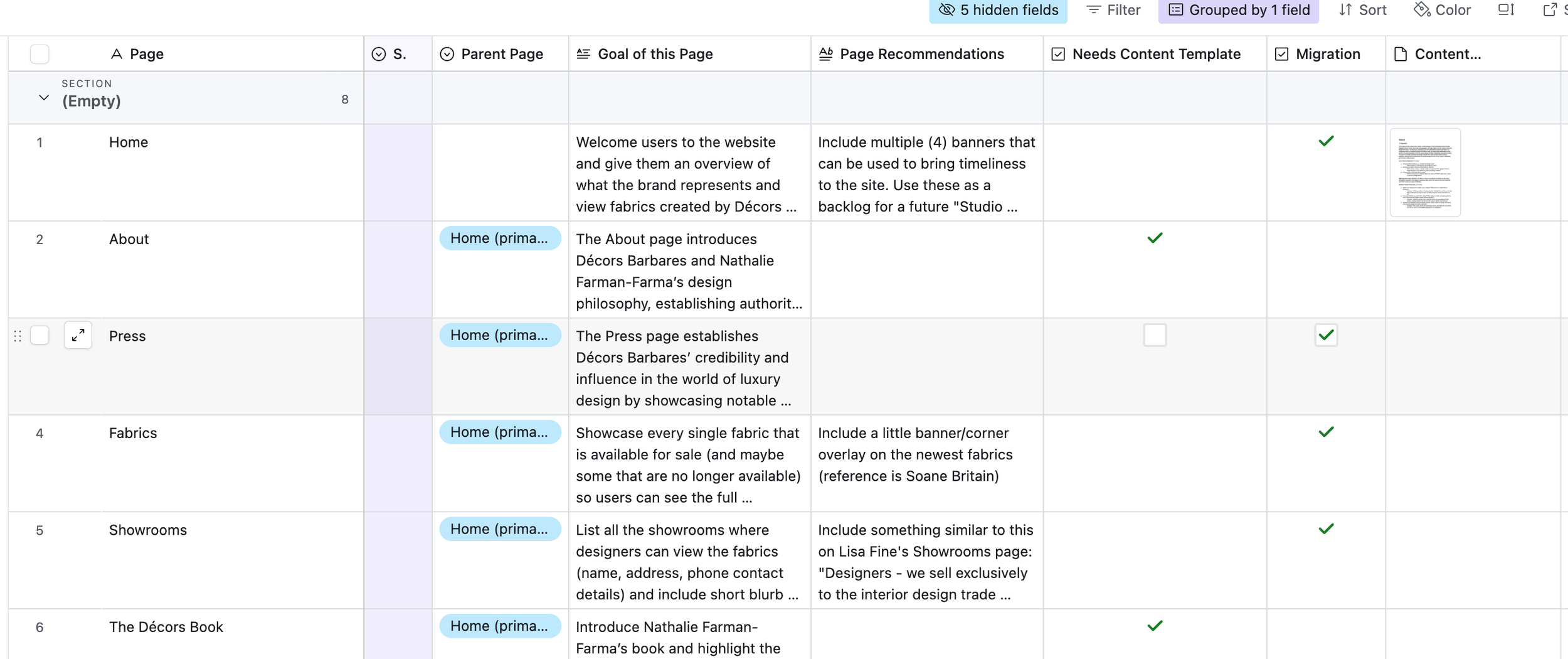
Content Management System All page-level recommendations, migration notes, and content status tracking were organized in Airtable, giving the client and development team a single source of truth throughout the build process.

Key Deliverables
A visual content strategy deck presented to the client, covering existing structure, proposed architecture, and content direction
Page-by-page content briefs with migration guidance, new copy recommendations, and design references
Social media positioning recommendations across two brand accounts
A newsletter/Substack proposal to extend audience engagement beyond the website
An Airtable content tracker for the development team
Tools & Platforms
Figma, Airtable, WordPress (final build)